The $200 AI Ceiling: Why Developers Are Flocking to a Free Offline Agent
Imagine coding at 30,000 feet on a cross-country flight. You have no Wi-Fi, yet an artificial intelligence assistant is autonomously building your project from...
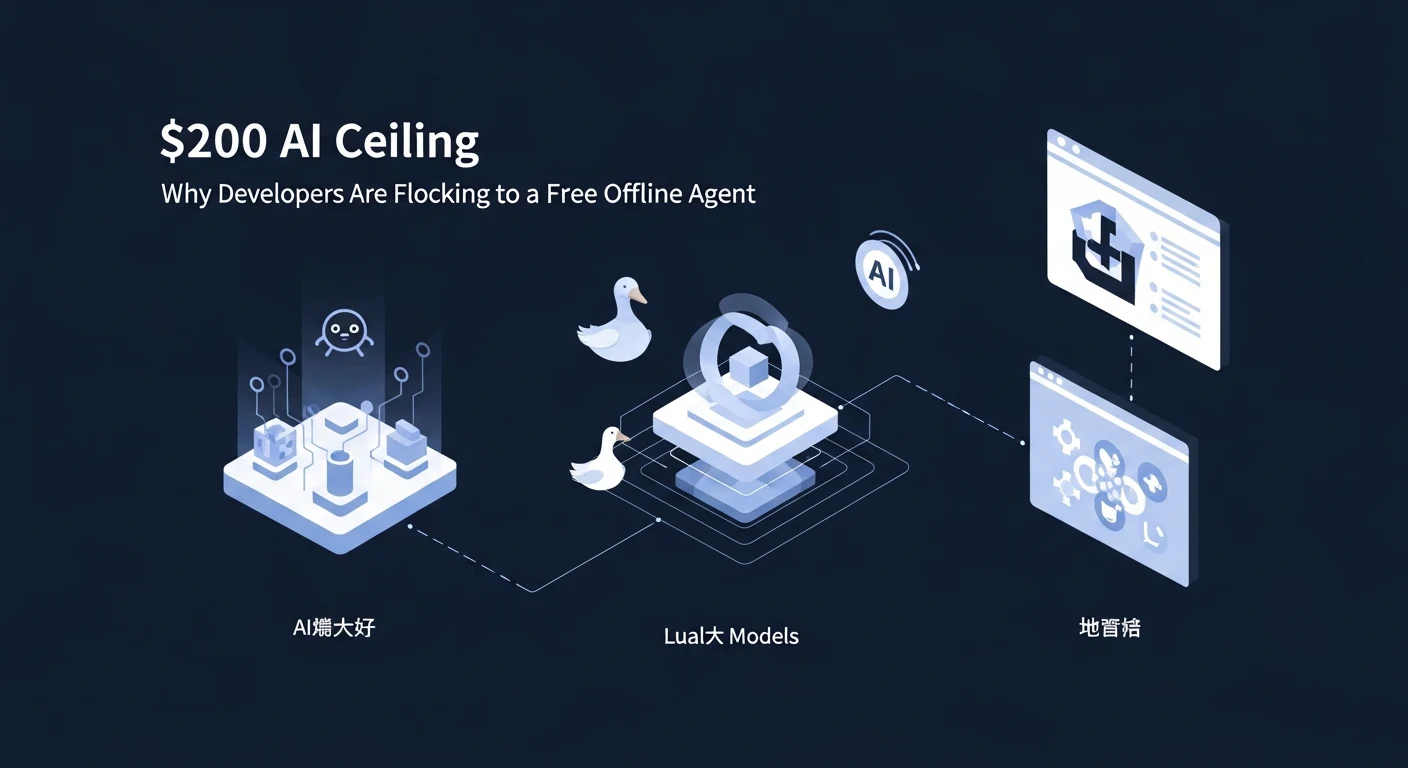
Imagine coding at 30,000 feet on a cross-country flight. You have no Wi-Fi, yet an artificial intelligence assistant is autonomously building your project from scratch, debugging errors, and executing commands right on your laptop.
This isn't a glimpse into the distant future—it's happening right now, and it represents a growing rebellion against the rigid, subscription-heavy business models of today's biggest AI companies.
For the past year, the narrative around AI coding tools has been dominated by massive cloud-based systems. Anthropic’s Claude Code, a terminal-based agent capable of writing and deploying software autonomously, has been a darling of the industry. But that power comes with a hefty price tag and frustrating strings attached. Costing anywhere from $20 to $200 a month, Claude Code imposes strict usage limits. Anthropic recently introduced a convoluted system of "hours" that actually translates to token-based limits. For serious developers, these limits can be exhausted within 30 minutes of intensive work, leading to fierce backlash on developer forums.
Enter Goose, an open-source alternative that is rapidly gaining traction. Developed by Block—the financial technology company led by Jack Dorsey—Goose offers functionality that rivals premium commercial tools, but with a radically different philosophy: it's entirely free and runs locally on your machine.
What makes Goose stand out is its model-agnostic architecture. While it can connect to cloud-based powerhouses like Google's Gemini or OpenAI's models via APIs, its true appeal lies in its ability to run entirely offline using local models through tools like Ollama. This means no subscription fees, no arbitrary usage caps that interrupt your workflow, and zero cloud dependency.
More importantly, it solves the glaring privacy issue inherent in cloud AI. "Your data stays with you, period," software engineer Parth Sareen noted during a recent demonstration of the tool. For enterprise developers handling proprietary codebases, the assurance that their code isn't being beamed to a third-party server for processing is invaluable.
The developer community's response has been electric. Goose has already amassed over 26,000 stars on GitHub, with hundreds of contributors pushing out updates at a rapid pace. Unlike basic autocomplete assistants, Goose utilizes "tool calling," allowing the AI to actually execute actions—like creating files or running test suites—rather than just suggesting the text for them.
The sudden rise of Goose highlights a pivotal shift in how we interact with artificial intelligence. As AI transitions from a novel experiment to a daily workplace necessity, users are increasingly pushing back against the "rental" model of intelligence. The massive popularity of this open-source project suggests that for many professionals, the ultimate luxury isn't access to the biggest cloud model—it's having an AI that you actually own and control.
Key Points
- Commercial AI coding agents like Claude Code charge up to $200/month but impose strict usage limits that frustrate developers.
- Block's open-source agent, Goose, offers a completely free, local alternative that requires no internet connection.
- Goose allows users to choose their preferred language models, prioritizing data privacy by keeping all code on the user's machine.
- Using advanced 'tool calling', Goose doesn't just suggest code—it autonomously executes workflows, builds projects, and debugs.
Why It Matters
The popularity of local, open-source AI agents signals a shift away from expensive cloud subscriptions, highlighting a growing demand for data privacy and user sovereignty in AI tools.
Sources:
更多专栏

The Cryptographer's Warning: AI and the Speed of Surprise
Imagine waking up to a digital world where secure communication is mathematicall...

The Skyward Shift: Meet the Drone Traffic Controllers
When we imagine the impact of artificial intelligence on the job market, the nar...

The End of the AI Black Box
Imagine buying a high-performance car with the hood welded shut. You can drive i...