The Code Commander: Orchestrating AI Agents for Next-Gen Development
Imagine a programmer not hunched over a keyboard, meticulously typing lines of code, but rather orchestrating a small army of intelligent AI agents, each...
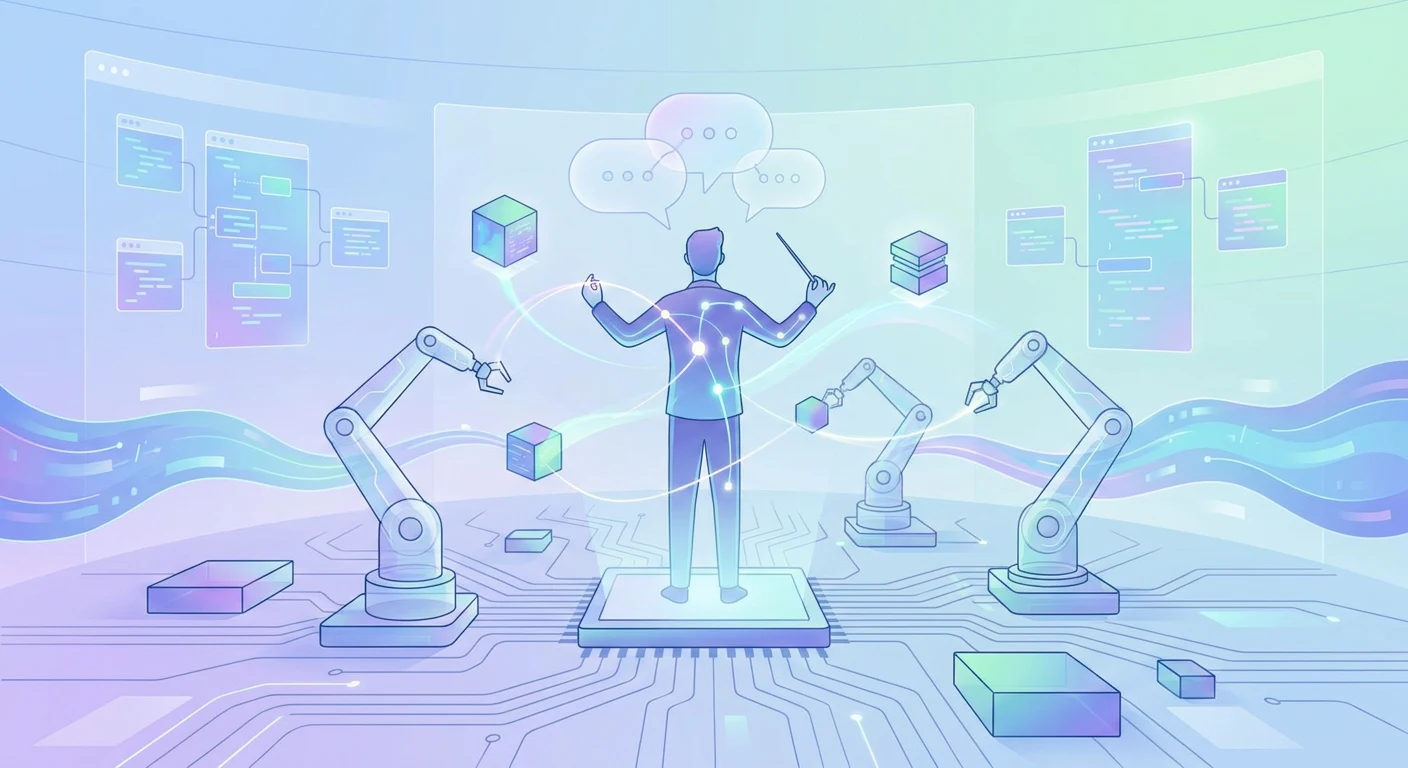
Imagine a programmer not hunched over a keyboard, meticulously typing lines of code, but rather orchestrating a small army of intelligent AI agents, each handling a specialized task. This isn't a scene from a futuristic film, but the current reality for Boris Cherny, the creator of Claude Code at Anthropic, who has unveiled a revolutionary approach to software development.
Cherny's groundbreaking workflow centers on running multiple Claude AI agents simultaneously. He operates five agents in his terminal and manages another five to ten in his browser, all in parallel. Rather than a linear process, he views coding as a real-time strategy game, where he, the human, acts as the commander, deploying and coordinating AI 'units.' While one agent runs a test suite, another might be refactoring legacy code, and a third could be drafting documentation, all managed efficiently through system notifications.
Perhaps counter-intuitively, Cherny exclusively uses Anthropic's heaviest and slowest model, Opus 4.5. His reasoning? While it takes longer to generate output, its superior intelligence leads to fewer errors, drastically reducing the human time spent on corrections. This challenges the industry's obsession with speed, suggesting that investing in a 'smarter' AI upfront can lead to greater overall efficiency by minimizing the 'correction tax' later on.
AI, like humans, can make mistakes. To tackle this, Cherny's team maintains a special file, CLAUDE.md, within their git repository. Any time an AI makes an error, the mistake is documented there. This simple yet effective method allows the AI to 'learn' from its past missteps, preventing repetition and fostering continuous improvement, effectively giving the AI a persistent memory and learning capability.
Beyond parallel processing and intelligent model selection, Cherny's system incorporates rigorous automation. He employs custom slash commands, like /commit-push-pr, to streamline complex, repetitive tasks. Furthermore, specialized 'subagents' are deployed for specific phases of development, such as a code simplifier for architectural cleanup or an app verifier for end-to-end testing. Crucially, his AI doesn't just write code; it verifies its own work, utilizing browser automation for UI testing or executing test suites to ensure functionality and user experience are up to par. This self-verification loop significantly enhances the quality of AI-generated code.
Cherny's workflow offers a compelling glimpse into the future of software engineering. It redefines the programmer's role from a solitary coder to an orchestrator of intelligent systems, dramatically boosting individual productivity. This paradigm shift underscores a future where human ingenuity, amplified by sophisticated AI collaboration, unlocks unprecedented possibilities in creation and innovation.
Key Points
- Boris Cherny manages multiple Claude AI agents in parallel, transforming coding into a real-time strategy game.
- He prioritizes the slowest but smartest model, Opus 4.5, arguing its higher quality reduces human correction time and improves overall efficiency.
- A
CLAUDE.mdfile in the git repository allows AI to learn from past mistakes, enabling continuous self-improvement. - Automation via slash commands and specialized subagents, coupled with AI's self-verification capabilities, ensures high-quality code.
- This workflow signals a shift in the developer's role to an AI orchestrator, dramatically increasing productivity and shaping future human-AI collaboration.
Why It Matters
Understanding how leading AI developers leverage AI tools can help general readers grasp the potential of AI agents and consider how similar multi-tasking, intelligent collaboration models could be applied in their own fields to boost efficiency.
Sources:
更多专栏

The Cryptographer's Warning: AI and the Speed of Surprise
Imagine waking up to a digital world where secure communication is mathematicall...

The Skyward Shift: Meet the Drone Traffic Controllers
When we imagine the impact of artificial intelligence on the job market, the nar...

The End of the AI Black Box
Imagine buying a high-performance car with the hood welded shut. You can drive i...